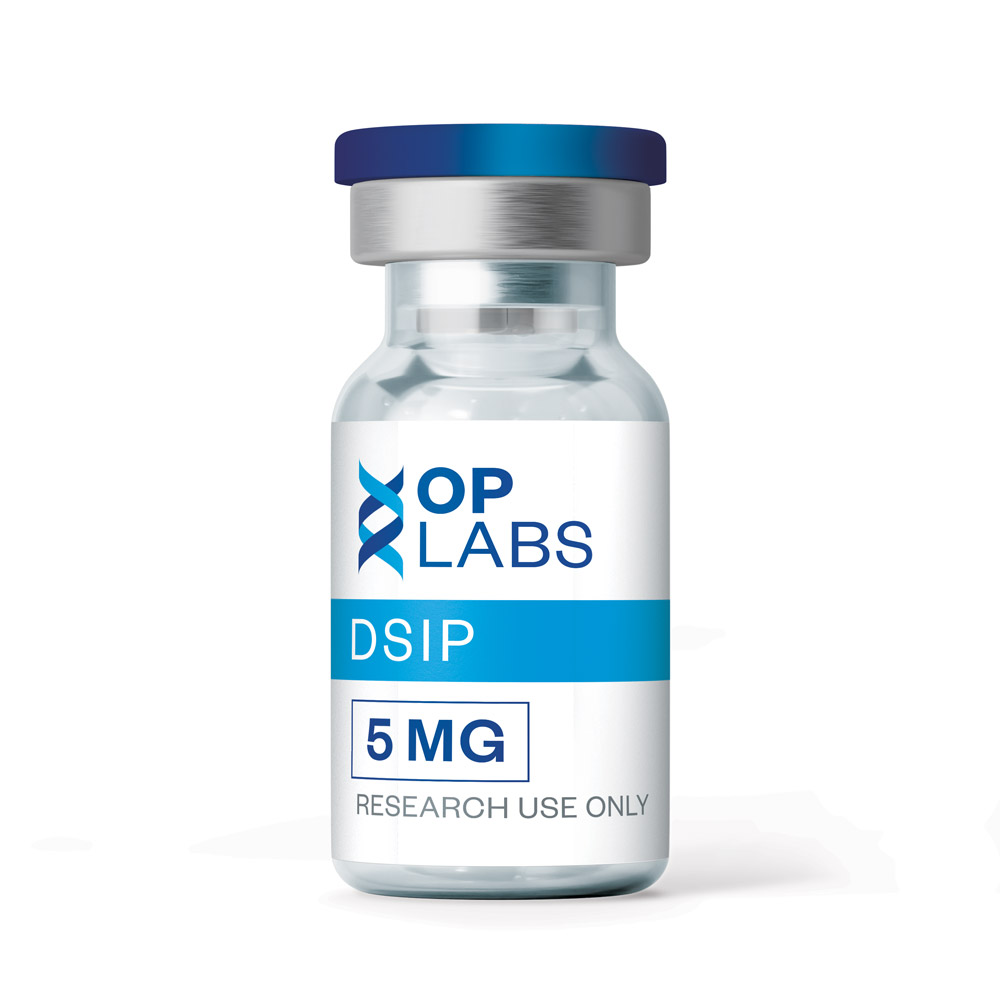
OP Labs formerly Oxford -PeptidesBatch HPLC tested at 99% purityStore frozen long term or in fridge when ready to be usedSold for research purposes onlyContact us for Wholesale OrdersDownload COA here: DSIP_COA.pdfPlease note: if you have a different Batch ID, please contact us for the latest COA.DSIPSynonyms / Designations: DSIP, Delta Sleep–Inducing Peptide, Delta sleep peptideCAS Number: 62568-57-4Molecular Formula: C₃₅H₄₈N₁₀O₁₅Molecular Weight:~848.82 g/molPeptide Classification: Naturally occurring nonapeptide; classified as a neuropeptide in experimental modelsPurity: ≥ 99 % (HPLC, typical)Appearance: White to off-white lyophilised powderPack Size: 5 mg (total)Storage: Desiccated, protected from light, stored at –20 °CSolubility: Soluble in water, dilute acetic acid, and phosphate-buffered saline (PBS)Description & MechanismDelta Sleep–Inducing Peptide (DSIP) is a naturally occurring nonapeptide first identified in studies of neurochemical signalling associated with sleep-related brain activity. It has been detected in central nervous system tissues, peripheral organs, and various biological fluids across multiple animal models, although its biosynthetic origin and precursor structure remain incompletely characterised.In biochemical and cellular research systems, DSIP has been examined for its involvement in neuroendocrine signalling, stress-associated pathways, and peptide–receptor interactions. Experimental studies suggest that DSIP may interact with multiple signalling mechanisms, including NMDA receptor–related pathways and MAPK-associated signalling cascades, with observed effects dependent on concentration, exposure duration, and experimental context. DSIP is primarily utilised as a molecular tool to investigate neuropeptide signalling rather than defined physiological outcomes.Applications in ResearchAs a molecular probe for studying neuropeptide-mediated signalling in central nervous system modelsInvestigation of peptide interactions within neuroendocrine and stress-related pathwaysIn vitro studies examining peptide stability, degradation, and carrier-protein interactionsAs a reference compound in research involving short endogenous neuropeptidesHandling, Reconstitution & StabilityWeigh under dry conditions; peptide is hygroscopicReconstitute in sterile water, dilute acetic acid, or appropriate buffered aqueous solution depending on assay requirementsAvoid vigorous agitation during dissolutionFilter sterilize if required (e.g. 0.22 µm) immediately prior to useAliquot and store reconstituted solutions at –20 °C (or lower) to minimise degradationAvoid repeated freeze–thaw cyclesDue to reported low intrinsic stability in vitro, prepare fresh working solutions when possibleSpecifications SummaryParameterTypical Value / RangePurity (HPLC)≥ 99 %AppearanceWhite to off-white lyophilised powderMolecular Weight~848.82 g/molPeptide TypeSynthetic nonapeptideSolubilityWater, dilute acids, PBSStorage–20 °C, desiccated, darkPack Size5 mgPrecautions & NotesExperimental behaviour of DSIP is dependent on concentration, exposure duration, and model systemBuffer composition, pH, and enzymatic activity may influence peptide stabilityDue to reported rapid degradation in some in vitro systems, appropriate controls are recommendedLiterature reports describe heterogeneous and sometimes contradictory findings across modelsIntended strictly for laboratory research use; not for human or veterinary applicationReferencesSchneider-Helmert D., Schoenenberger G.A. Effects of DSIP in man. Multifunctional effects of a neuropeptide. Neuropsychobiology, 1983.https://pubmed.ncbi.nlm.nih.gov/1299794/Kovalzon V.M., Strekalova T.V. Delta sleep-inducing peptide (DSIP): a still unresolved riddle. Journal of Neurochemistry, 2006.https://pubmed.ncbi.nlm.nih.gov/16539679/Bocheva A. et al. DSIP and its analogues: potential neuroprotective research applications. Molecules, 2021.https://www.mdpi.com/1420-3049/26/17/5173Keywords: DSIP, Delta Sleep–Inducing Peptide, Synthetic Nonapeptide