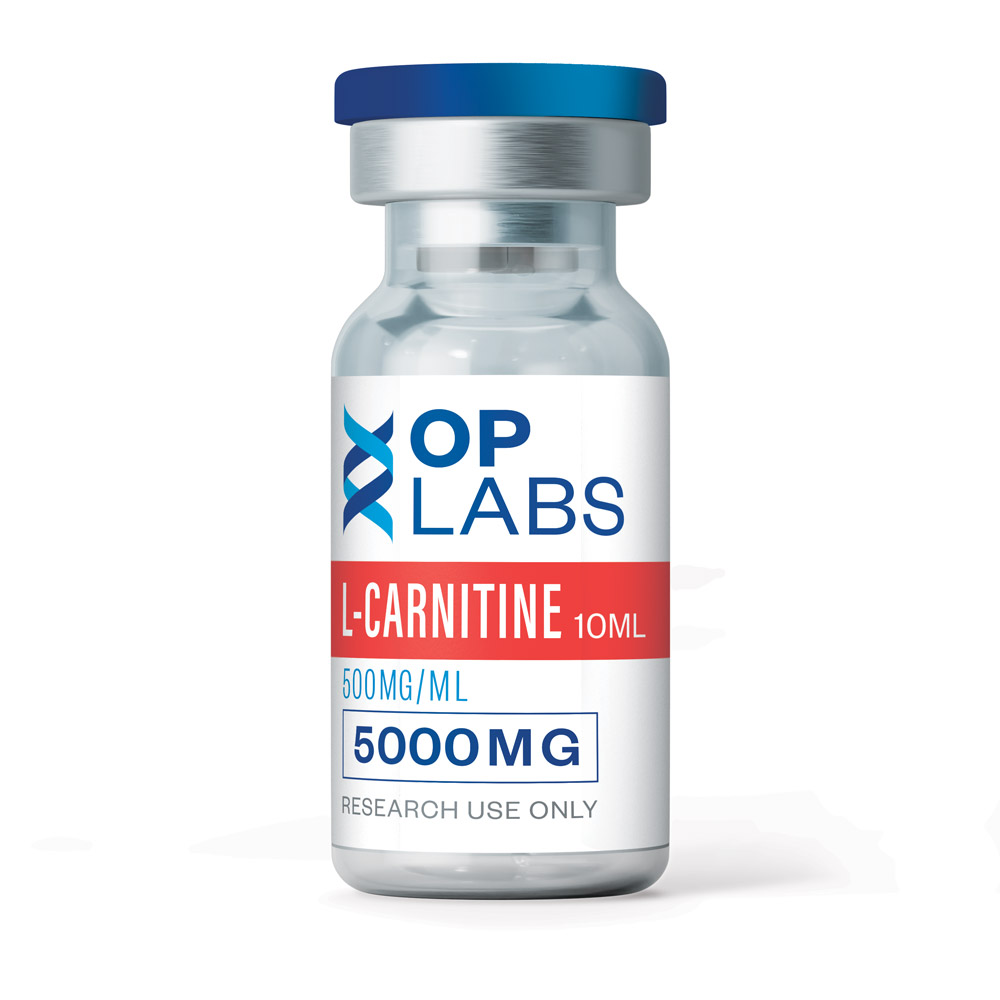
OP Labs formerly Oxford PeptidesBatch manufactured to defined specificationStore in a cool dark placeSold for research purposes onlyContact us for Wholesale OrdersDownload COA here: L-Carnitine_COA.pdfPlease note: if you have a different Batch ID, please contact us for the latest COA.L-CarnitineSynonyms / Designations: L-Carnitine, Levocarnitine, (R)-3-hydroxy-4-(trimethylazaniumyl)butanoateCAS Number: 541-15-1Molecular Formula: C7H15NO3 Molecular Weight: 161.20 g/molChemical Classification: Naturally occurring quaternary ammonium compound; zwitterionic small moleculePurity: Manufactured to ≥ 99 % chemical purity (typical, specification-based)Appearance: Clear liquid.Pack Size: 10mlStorage: Store in a cool dark place. Discard 30 DAYS after opening.Description & MechanismL-Carnitine is a naturally occurring small molecule involved in mitochondrial fatty acid metabolism. In biochemical and cellular research systems, L-Carnitine functions as a carrier molecule facilitating the transport of long-chain fatty acids across the inner mitochondrial membrane via the carnitine shuttle mechanism.Within experimental models, L-Carnitine participates in reversible esterification reactions with acyl-CoA derivatives, forming acylcarnitines that are translocated into the mitochondrial matrix for β-oxidation. This process is central to studies of cellular energy metabolism, mitochondrial function, and lipid handling under controlled laboratory conditions.L-Carnitine is widely used as a reference compound in metabolic research due to its well-characterised chemical structure, stability, and conserved biochemical role across species.Applications in ResearchAs a molecular tool for studying mitochondrial fatty acid transport mechanismsInvestigation of cellular energy metabolism and β-oxidation pathwaysUse as a reference compound in metabolic, enzymatic, and transporter assaysIn vitro and ex vivo studies examining acylcarnitine formation and turnoverHandling & StabilityStore in a cool dark place. Discard 30 DAYS after opening.Shelf life: 36 MONTHS from productionSpecifications SummaryPurity: ≥ 99 %Appearance: Clear liquidMolecular Weight: 161.20 g/molChemical Type: Quaternary ammonium compoundSolubility: WaterStorage: Store in a cool dark place. Discard 30 DAYS after openingPack Size: 10mlPrecautions & NotesExperimental behaviour of L-Carnitine may depend on concentration, cellular model, and metabolic stateIonic strength and pH of assay buffers may influence transport and binding interactionsAppropriate controls are recommended to distinguish specific metabolic effects from osmotic or ionic effectsIntended strictly for laboratory research use; not for human or veterinary applicationReferencesBremer J. Carnitine—metabolism and functions. Physiological Reviews, 1983.https://pubmed.ncbi.nlm.nih.gov/6361812/McGarry J.D., Brown N.F. The mitochondrial carnitine palmitoyltransferase system. European Journal of Biochemistry, 1997.https://pubmed.ncbi.nlm.nih.gov/9063439/Hoppel C. The role of carnitine in normal and altered fatty acid metabolism. American Journal of Kidney Diseases, 2003.https://pubmed.ncbi.nlm.nih.gov/12751049/NIH PubChem. L-Carnitine. CID 10917.https://pubchem.ncbi.nlm.nih.gov/compound/10917Keywords: L-Carnitine, Levocarnitine, Carnitine Shuttle, Mitochondrial Metabolism, Fatty Acid Transport